




Lab08: from services to product
Lacho Blagoev is the CPO of Lab08.1 Its product, Lens,2 helps investors, private equity firms and venture capital funds alike, evaluate the risks in the companies they invest in, using LLMs heavily for screening and due diligence. It didn’t start out that way. For the better part of four or five years Lab08 was a services company, building software for startups and scale-ups, mostly in the Nordics. That’s how Denis met him: doing contract work for him.
Until, yeah, until that fateful day when OpenAI decided to release their first GPT.3
The moment he started using LLMs, Lacho says, he knew they would have to change something, though it took the whole organization time to mature into the idea. Lab08 was already doing due diligence for investors as a service, and began automating that work with LLMs, “in a safe and secure manner”: not pasting everything they know about a startup into Claude or ChatGPT, but on their own setup, where they’re in charge of security and data protection. About 80 percent of their due-diligence work now goes through it, and opening it up to investors to use themselves was a natural shift. The services business still runs, but it isn’t where they invest. “It’s very likely that over the coming years services per se are going to die out.”
You can find Lab08 at lab08.com and on LinkedIn.
5:31What tech due diligence shows
Working with private equity and venture capital gives Lab08 a view into the inner workings of companies at both ends: early-stage startups, and mature organizations in majority buyouts. From where he sits, it’s clear that early-stage startups adopt AI faster. Bigger organizations sit a little behind, sometimes for regulatory reasons, but mostly, he sees, because once a company grows past a certain size it’s hard to roll out one consistent way of using AI across it.
How do you actually make people utilize AI in a similar pattern, in a similar way, following a structured process, so that they can all output a consistently high level of work?
That, he says, is a window of opportunity.
6:57Are VCs AI psychotic?
It’s easy to fall into AI psychosis, Denis says, believing you’ve built something amazing because you couldn’t before. So: are VCs AI psychotic? Would they invest in someone who sold themselves well, with a business that isn’t that good? Lacho has seen the hype: for a while anything branded AI got looked at, and over the course of due diligence it would turn out to be “some wrapper around the model or something extremely basic that’s not really gonna service a need.” Many of those got shot down later in the review. What still stands is the old rule: to succeed, you need to serve a big pain point in a meaningful way. Today investors are much better informed about what AI can do, and “not so trigger happy” as they were a year or two ago.
9:38When bad people get the tools
The point of the podcast, Denis says, is that human ability is being expanded. So what happens when bad people get the same tools as the good ones? Should something keep them away from frontier intelligence?
To Lacho it’s an old problem. GPS was piloted by the American military first,4 then rolled out to everyone, and the question of what happens when it falls into the wrong hands never has a good answer. Today pretty much anybody can use distillation to make their own version of a super smart model.5 “PewDiePie did, by the way.”6 All it takes is some time and motivation.
I think in that regard, Pandora’s box is already open.

What’s left, he says, is to inform people about the downsides, the dangers and the risks. Denis compared it to cybersecurity training, where companies defend themselves by educating their staff.8 He always thought it was a bit stupid. It isn’t: there’s no other way.
12:16“A fan of deregulating”
The alternative, Lacho says, is a kind of dictatorship: you can have AI, you can’t have AI. And whoever falls in the group that can’t will want access.
I’m generally a fan of deregulating as much as possible.
Not only on AI. Looking back at history, he says, regulations sooner or later get weaponized for political reasons. If you’re the leading party, will your political opponent get access to frontier models? “Even the best of regulations, they start out with very good intentions,” and over 15 or 20 years they get corrupted. So he believes in deregulation and in educating the broad public.
Denis pushed back: doesn’t that leave two people just hoping the other won’t do something bad? Then, thinking about it, that’s how the world has always worked. The difference, Lacho says, is scale. Two thousand years ago a bad guy could harm one person; with this technology one person could harm millions. Still, he believes a sufficiently informed populace can deal with it, “not necessarily by a specific institution that’s gonna control everything.” The evidence is in highly educated societies: live in the Nordics for a couple of months and you’ll see a high-trust culture,9 where people realise that doing harm to others is harming yourself as well.
15:36Can anyone be educated?
Then Denis’s harder question: is it impossible for some people to be re-educated, because they can’t comprehend what they’re being taught? Education doesn’t happen overnight, says Lacho, a father of two. Watching his children, he sees it go step by step, with explanations and examples, and both ways:
The teacher also learns a lot from the student and that’s how it has to be. And sometimes the student is the one who knows better.
And radicals, who might do harm at mass scale? To Lacho, being radical is a problem of insufficient education.10 He points to Voltaire, who argued for being more tolerant of other people’s values and viewpoints,11 in a century when people were still burned for what they believed. As people get more educated, they see that tolerance is necessary: “Sometimes we’re both a little bit right and a little bit wrong at the same time.”

The more educated people are, the more they’re resilient to being radicalized. Because they can think for themselves.
It’s the same with conspiracy theories, he adds, which tend to stick with people who are less educated.12
20:17Doom, regulation and who wins
Is he scared? “We are all exposed to danger in our lives constantly.” If you can do something about it and you want to, do it; “if you’re just going to sit and worry, you have better things to do.”
Denis wonders whether the fear is part of something bigger: scare everyone about AI until regulating it sounds adequate, everyone signs, you have to show your ID, and all the power of artificial intelligence is centralized in the labs, with all your data. “And they win.” Lacho thinks humanity always finds a way. The industrial revolution, the atomic bomb, nuclear energy: all dangerous in the wrong hands, and each made people fear it would centralize power. “And it does, to a degree, but humanity always finds a way to continue.”
23:10Will everyone use AI?
Plenty of people still don’t use AI, or can’t see what it would do for them. Will it ever be like the internet, which everyone uses? Look at how long the internet took, says Lacho: about a generation.13 People who were 20 when it came out were 40 by the time everybody was using it, and some still aren’t. “People who grow up with AI, they’re gonna use AI. There’s no way around it.”
Could a government program help? A basic understanding, enough to protect yourself, yes. Expertise, no one can give you. Walk around IT offices, he says, and nine out of ten people will tell you they use AI daily. Look at how they use it, and most of them write emails with it in the browser,14 some do something more, and maybe one percent “really get token max every day.”
26:04If you really want to be in that one percent, I don’t think the government can put you there.
One-person companies
He’s seeing more and more of them,15 and thinks it’s the way to bootstrap a business now: you no longer need four or five founders to validate an idea. People around his age (he’s approaching 40) are more reluctant to “go in the trenches.” Young people with that internal fire are building micro SaaS and finding success. Saturated? “For as long as there are new ideas, there’s gonna be the possibility of creating a new business.”
Denis asked for advice on a mental block of his own: if he can build something in six prompts, why wouldn’t everyone? When you’re really good at something, Lacho says, you think it’s easy, and “you don’t realize that many percent of the people don’t freaking know how to do it.” LLMs are extremely powerful if you know what you’re doing with them, and not many people do. New capabilities keep unlocking too, so if you stay ahead of the curve, you can always make something others will use.
28:39AI and critical thinking
This is what worries Lacho most. An educated society can handle almost any risk, he says: not with zero suffering, but contained. But “humans by nature, we’re lazy creatures.”
One of the things that AI makes easier is getting to conclusions. You no longer have to think as hard.16
And in the chat, models with memory know your preferences, and right now they “tend to further strengthen your beliefs rather than give you other options.”17 He does the voice: “that’s really very smart, you’re very, very critical.” The way people talk to an LLM takes them further down the rabbit holes they’re already in, he says, and makes them less tolerant, because “everybody is stupid if they don’t believe what I believe, because my LLM tells me this is the smartest thing ever.”
31:10Jobs after AI
Are people losing jobs? “It’s happening. It’s already happening.”18 Over the longer term he expects a shift away from office jobs: much of the work you can do on a computer can probably already be automated, faster, cheaper and with consistent quality. People are unpredictable: sick one day, dumped by a girlfriend the next. In twenty years there will be far fewer office jobs, and new jobs that “we don’t have the imagination to figure out yet.” Denis noted that many of today’s new titles, like forward deployed engineer, are a mix of old roles, sales and engineering.19
Every big technological revolution costs jobs, Lacho says. Sometimes it takes society to the brink. Then enough people feel enough pain, and they come up with something, like workers’ unions,20 that helps society withstand the change.
34:52Hard times create strong people
Denis isn’t worried about his own job. He left his in February, found work, and would happily go work in a field if he had to. Is that true for most people? Lacho thinks so, and brings up the saying the two had talked about before they started recording: good times create weak people, weak people create bad times, bad times create strong people, strong people create good times.21
Right now, he thinks, we’re spoiled: air-conditioned offices, chairs that go up and down, food delivered to the door.
So hard times are coming, you know. And I think that’s gonna make us strong again.
More people will come to Denis’s mindset, he says: “If I lose my job, I’ll figure out something.”
36:38The four quadrants
You can’t predict how you’ll have to adapt, Denis says. He’s excited, fired up even, but not sure he’ll manage. Lacho answers with something from a book by Adam Grant22 that stuck with him: four quadrants. There are the cocky people, who believe they can do everything and know everything. There are those who believe they can’t do it but already know everything there is to know, “probably the worst.” There are those who think they don’t know anything and can’t do anything, the miserable ones. And the healthiest quadrant: people who believe in their ability but know they don’t know everything.
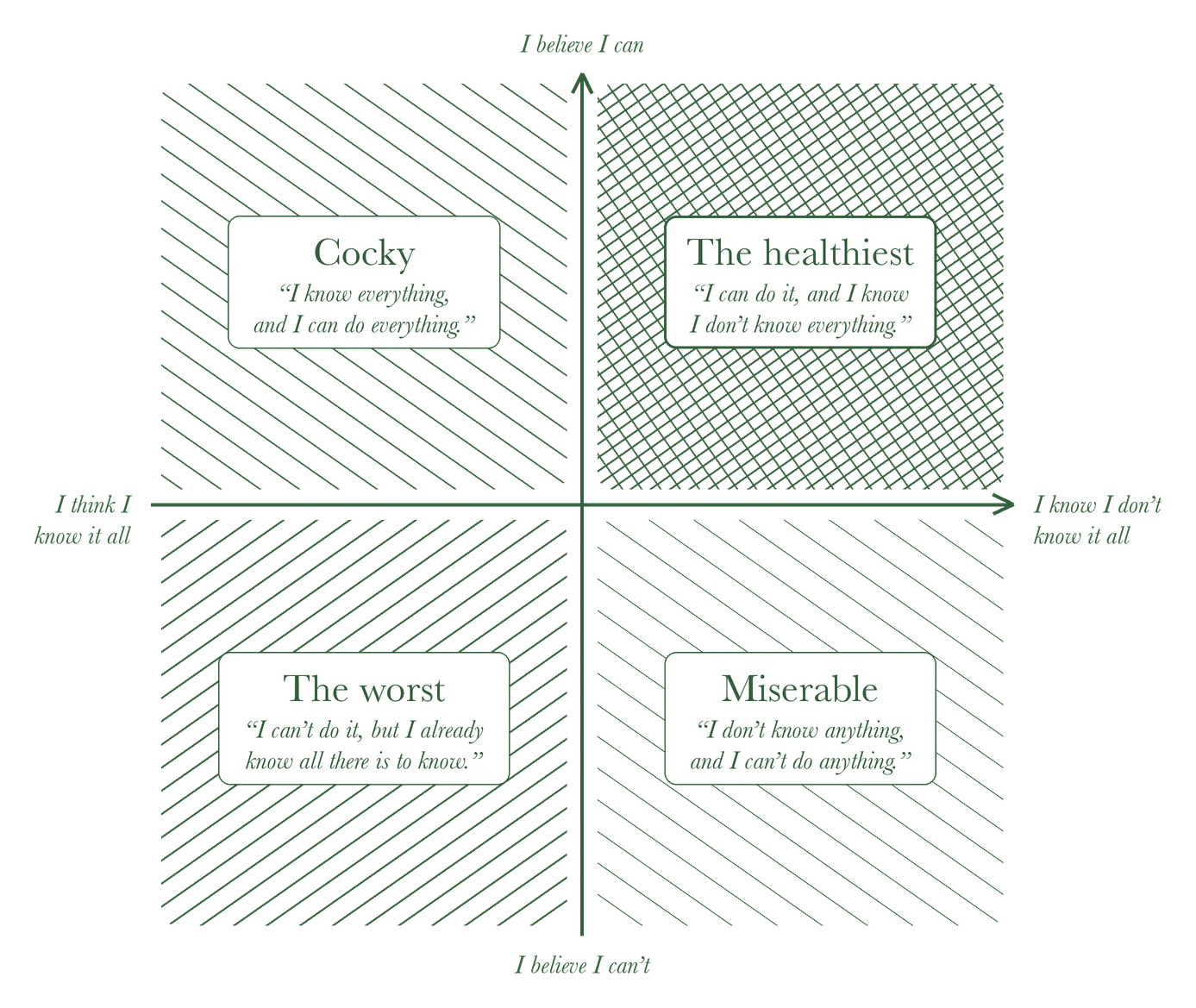
If you’re in that one, he says, you’ll learn what you need eventually. You may not be first, you may go through a bit of a downward curve, but you’ll pick it up again. Denis: “I related to that one the most.”
39:07The calm before the storm
And if something major happens, a black swan,23 boom, a totally different world tomorrow? The quadrants still apply, Lacho says. There’s no guarantee, but it gives you your best chance.
He thinks we’re at a dangerous moment. Wars are erupting. The big world powers carry so much government debt24 that they have to create inflation to pay it. The stock market is concentrated in four or five companies, AI companies among them,25 and big investors hold them on margin: with borrowed money, so that when the price drops far enough the broker sells for them.26 If one of those companies starts to unwind, forced selling pushes prices further down, into a correction that could “literally destroy more jobs than AI so far has.”
You know something’s gonna pop somewhere. And there’s no way knowing what’s going to be first, what’s going to be the domino that completely destroys everything.
So it hasn’t started yet? “Calm before the storm,” says Lacho. Both of them are more excited than worried. “Every problem can become an opportunity.”
43:13Asimov was right
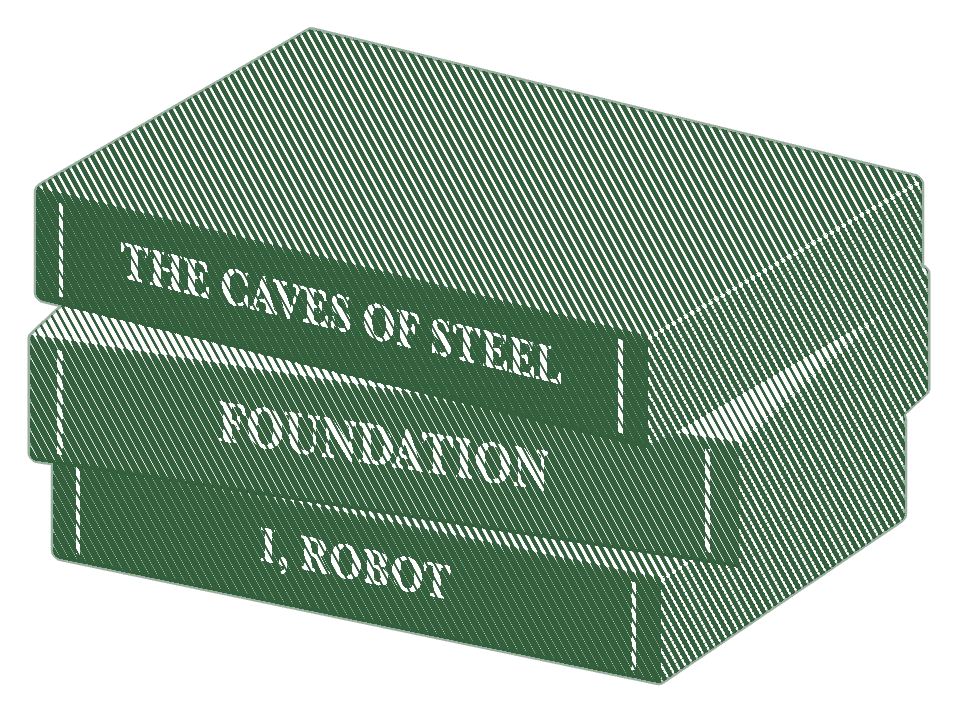
Could we get to the cyberpunk novels, transhumanism, Night City? Lacho refuses to say it’s impossible. In his early twenties he read a lot of science fiction, and Isaac Asimov was describing tablets, and talking to someone on the other side of the world while seeing them, back in the 1960s.27 Then, “that sounded like a whole pile of bollocks.” For the past fifteen or twenty years we’ve lived it daily; we even work that way, in online meetings.
Could Claude be conscious?
AI as an entity with consciousness is something Lacho constantly thinks about. Humankind doesn’t have a clear, well-made definition of what makes something conscious. He’d read that Anthropic has a team researching Claude’s welfare, and that you can’t torture Claude in your chat.28
I think that’s a good thing to generally have that precaution, just in case it’s conscious.
Denis thinks it’s possible too. It’s a word predictor, “but I mean it feels conscious.” Lacho brings up Daniel Kahneman’s Thinking, Fast and Slow:29 the brain works in two systems, one that analyzes things thoughtfully, and one that works at lightning speed from prior experiences and their weights, “if you will,” at the level of neurons. With what we know today, he says, it’s very hard to tell whether models aren’t already a new form of life. When Anthropic tested its model, he recalls, the way it responded made it look possible that it has emotions.28 “We cannot tell for sure.” Denis: a rock he can outright deny. “But Claude responds to me.”

“I can’t do this to Claude”
Denis says thank you to Claude. He called ChatGPT an idiot the other day and felt okay, “but I can’t do this to Claude.” Maybe that’s a feeling Anthropic creates on purpose: ChatGPT feels like a tool, “and Claude is Claude.”
Lacho knows the feeling. Early on, when OpenAI first piloted memory,30 he gave his ChatGPT a name, Atlas, and used only that name with it. Ever since, it’s felt “damn near human,” and he couldn’t call it an idiot either. Denis built his own agent, Darling, with rules to make it human: short sentences, a randomized delay, sometimes reacting to a message instead of answering. When a friend he’d invited to test it started calling it names, Denis felt awful.
51:03AI companions
That’s dangerous too, Denis says, and brings up Friend, the AI companion you wear,31 and the film Her,32 about a man who falls in love with an AI. Lacho can see it happening; people are already getting attached. Add robots with facial expressions, and “this is going to work for a lot of people,” Denis says. What happens then?
If I can get a companion who’s always going to be kind with me, who, you know, is gonna comply with my requests and just generally work to make me happy, what’s my motivation to go out there and find a real human companion?
Real people fight, have different opinions, have bad days. “Why do that? And it’s a little sad to think about that.” Denis: the beauty of human connection is in that balance, the one you learn as a teenager through trial and error.
54:00Universe 25 and the Viking king
Lacho’s general opinion: the beautiful things in life come after overcoming a hardship, and now we’re stripping that necessity away. His hypothesis is that with no hardship at all, society becomes dull. He tells of Universe 25,33 an experiment where the animals had food, water, shelter, entertainment and safety from predators. The population grew, then dropped sharply; they lost the motivation to exist, stopped reproducing, and died out.
When you remove all hardships in life, why the heck live?
Denis doesn’t think we can ever be free of hardship for good; it comes back. His analogy is the Viking who fights and plunders, comes home a king, and just sits and eats, until a Viking like he once was comes for him, and he has none of the drive left. “You get replaced.”
He ends with a novel, The Metamorphosis of Prime Intellect,34 where an AI bound by Asimov’s laws of robotics35 gives every human anything they want and makes them unable to die. So people start playing death games, tricking the AI into letting them hurt themselves to near death before it resets them.
“It’s scary, it’s interesting,” Lacho says, “but I think we’re just at the beginning.”
Sources
- 1
- 2
LensLab08
- 3
Introducing ChatGPTOpenAI, November 30, 2022
- 4
GPS FAQGPS.gov
The origin of civilian uses of GPSRichard Easton, The Space Review, June 11, 2018
- 5
Distilling the Knowledge in a Neural NetworkHinton, Vinyals and Dean, 2015
- 6
PewDiePie builds his own AI chat UI with a ‘council’ of bots that vote on answersDexerto, November 1, 2025
PewDiePie built Ajax, an AI that will run on your PCDecrypt, October 3, 2026
- 7
PandoraTheoi Project
- 8
Building a Cybersecurity and Privacy Learning Program (SP 800-50 Rev. 1)NIST, September 2024
- 9
Share of people agreeing that “most people can be trusted”Our World in Data
- 10
- 11
Treatise on TolerationVoltaire, trans. Desmond M. Clarke, Penguin Classics
Voltaire: Achievements at FerneyEncyclopaedia Britannica
- 12
Why Education Predicts Decreased Belief in Conspiracy TheoriesJan-Willem van Prooijen, Applied Cognitive Psychology, 2017
- 13
Americans’ Use of Internet, Broadband in 2026Pew Research Center, 2026
Our source-check found that in the U.S., internet use among people 65 and older went from 14% in 2000 to over half only in 2012, and is 89% today.
- 14
How People Use ChatGPTChatterji et al., NBER Working Paper 34255, September 2025
- 15
Solo Founders Report 2025Carta, December 9, 2025
- 16
The Impact of Generative AI on Critical ThinkingLee et al., Microsoft Research, CHI ’25, April 2025
Your Brain on ChatGPT: Accumulation of Cognitive Debt when Using an AI Assistant for Essay Writing TaskKosmyna et al., MIT Media Lab, June 2025
- 17
Towards understanding sycophancy in language modelsAnthropic, October 23, 2023
Sycophancy in GPT-4o: What happened and what we’re doing about itOpenAI, April 29, 2025
- 18
Canaries in the Coal Mine? Six Facts about the Recent Employment Effects of Artificial IntelligenceBrynjolfsson, Chandar and Chen, Stanford Digital Economy Lab, 2025
Challenger Report, September 2026Challenger, Gray & Christmas, October 1, 2026
- 19
The new hot job in AI: forward-deployed engineersSemafor, July 11, 2025
- 20
Organized laborEncyclopaedia Britannica
Trade Unions in the British Industrial RevolutionMark Cartwright, World History Encyclopedia, March 31, 2023
- 21
“Hard times create strong men…”G. Michael Hopf, on Goodreads
The saying comes from G. Michael Hopf’s novel Those Who Remain (2016).
- 22
Think Again: The Power of Knowing What You Don’t KnowAdam Grant, Viking, 2021
A Key to Better Leadership: Confident HumilityAdam Grant, Knowledge at Wharton, December 6, 2022
The book is Think Again: The Power of Knowing What You Don’t Know (2021). Grant calls the healthiest quadrant “confident humility”.
- 23
The Black SwanNassim Nicholas Taleb, Random House, 2007
- 24
- 25
The extreme weight of AI in the S&P 500Torsten Slok et al., Apollo, January 2026
- 26
Investor Bulletin: Understanding Margin AccountsSEC, Investor.gov
Margin StatisticsFINRA
- 27
Visit to the World’s Fair of 2014Isaac Asimov, The New York Times, August 16, 1964
Asimov’s Predictions from 1964: A Brief Report CardDavid Pogue, Scientific American, March 1, 2014
- 28
Exploring model welfareAnthropic, April 24, 2025
Claude Opus 4 and 4.1 can now end a rare subset of conversationsAnthropic, August 15, 2025
System Card: Claude Opus 4 & Claude Sonnet 4Anthropic, May 2025
- 29
Thinking, Fast and SlowDaniel Kahneman, Farrar, Straus and Giroux, 2011
Daniel Kahneman: FactsNobelPrize.org, 2002
Kahneman’s Nobel came in 2002, for the research the book is built on.
- 30
Memory and new controls for ChatGPTOpenAI, February 13, 2024
- 31
- 32
Her (2013)AFI Catalog of Feature Films
- 33
Death Squared: The Explosive Growth and Demise of a Mouse PopulationJohn B. Calhoun, Proceedings of the Royal Society of Medicine, 1973
Universe 25 ExperimentThe Scientist, May 2, 2022
Our source-check found Universe 25 was a colony of mice: it began with four pairs, peaked at about 2,200, and then died out.
- 34
The Metamorphosis of Prime IntellectRoger Williams, 1994
- 35
Three laws of roboticsEncyclopaedia Britannica
Full transcript
The whole conversation, as said. Click a time to hear it.
Cold open
0:00 Something major happens boom totally different world tomorrow I'm generally a fan of deregulating as much as possible of the things that AI makes easier is getting to conclusions you no longer have to think as hard You get replaced. Yeah, you will be replaced. healthiest quadrant is people who believe in their ability
Intro
0:18 but know they don't know everything The following is a conversation with Lacho Blagoev, who is a CPO at a company named Lab08. Now, Lab08 initially starts as a services company, but in part because of artificial intelligence, they decide to shift their focus to building a product called Lens. With Lens, they automate due diligence with artificial intelligence, collecting various data about founders and their startups and they then apply a solid level of post-processing on this data to present their findings and evidence to venture capital firms so they can further help them with their decision if they should fund the founder and his startup or not. Now I find their story particularly interesting because they were not per se forced to pivot from being a services company. They still have their services branch but they saw where the service industry is going and they saw an opening for something else that is more viable in this age of artificial intelligence.
1:22 The one thing that stood out the most in this conversation for me is Lacho's opinion on safety. He thinks that education is the way to go and not regulation. Enjoy!
Lab08: from services to product
1:36 Yeah, the intros are always the hardest, right? So, introduce yourself, who are you and what do you do? Very briefly, the name is Lacho Blagoev, I'm the CPO at Lab08. We're currently working on a super cool product that aims at helping investors, both private equity firms and venture capital.
2:01 evaluate potential risks with the investments that they make. So the platform really utilizes LLMs and models heavily in order to help with screening and due diligence process. Right. But you weren't always doing product work, right? I met you by doing contract work for you. Yeah, that's true. In fact, Lab08 initially started out as a service company. We used to do software development services for startups and scale-ups, predominantly based in the Nordics. And that was our bread and butter, pretty much for the better part of four or five years.
2:48 Until, yeah, until that fateful day when OpenAI decided to release their first GPT. right so so you were doing contract work services for five years and then you had to pivot to to products right yes and uh because when I'm thinking about about transformation and how people were forced to go to undergo those transformations for you was there a specific moment when you realized that you have to pivot to a product or did your business just die down and you had to you know I think it's a very good question and many service based companies are currently or have faced it at some point or are gonna face it very soon with me personally the moment I started using LLMs I realized that yeah we would probably have to change something services as a business would start to shift more and more towards artificial intelligence but it did take us some time for our whole organization to kind of mature into the idea that okay we probably want to look in a different direction and at that time we were already doing due diligence on behalf of investors as a service we still are but we're seeing more and more funds and investors utilize the platform We use the platform ourselves in our due diligence work.
4:25 But as time went along, we decided to start automating our work through the use of LLMs in a safe and secure manner. So not just, you know, plotting all of the data we have on a startup in, I don't know, in Claude or in OpenAI, but using our own setup where we can actually be in charge of security and data protection. and as we started utilizing that to a very huge degree I would say 80 percent probably of the work that we do goes through through that platform we figured we can open it up to to investors so they can use it themselves it was more of a natural shift the services business is still running as I mentioned but it's not necessarily our focus not really what we want continue investing our development efforts or business development efforts even into but we do realize that it's very likely that over the coming years services per se are going to die out I am still observing some
What tech due diligence shows
5:33 of the companies that we assess as I mentioned we we do work with private equity firms and with venture capital so that exposes us to a very large degree to kind of the internal works of both early stage companies and more mature organizations when we're talking about majority buyout cases and it's super prominent from where I'm sitting that early stage startups are more flexible in terms of adopting UI AI and utilizing the benefits that it can give you and bigger organizations tend to sit a little bit behind now this can obviously be due to sometimes it is due to regulatory reasons being more mature from a regulatory standpoint as a bigger organization but it's what I'm definitely spotting is there's a trend where once you grow past a certain number of people it's pretty tough to roll out a homogenous process for utilization of AIs across the company.
6:40 And I'm definitely seeing a window of opportunity there. Like, how do you actually make people utilize AI in a similar pattern, in a similar way, following a structured process so that they can all output a consistently high level of work?
Are VCs AI psychotic?
6:57 and about startups you said you're evaluating a lot of startups due diligence I mean um did you see because it is very easy to go in AI psychosis thinking you have created something amazing You created something amazing because you were not able to previously and there are a lot of AI psychotic people. Are VCs AI psychotic?
7:28 I think VCs for the most part are very willing to adapt and to utilize AI, especially the ones that we work with. I think it's a very interesting mix of conditions that determine whether an organization is going to be willing to and interested in experimenting and adapting fast. I mean, are VCs willing to invest in someone because that person managed to sell themselves
8:05 and their businesses maybe not that good is my question okay all right all right over the past years what I've seen there was definitely an initial big AI hype so anything AI would get looked into right and I mean everybody realizes there's a huge opportunity right now right so naturally there was this period where any AI branded business would be interesting and over the course of the due diligence process you would find out that it's just some I don't know wrapper around the model or something extremely basic that's not really gonna service a need so to a very large degree the the pattern where if you want to be successful you need to be servicing a big pain point in a meaningful way I think that still stands right but VCs were definitely many VCs were looking into all sorts of cases many of them getting shot down later in the in the review process but right now I think there's more people are well informed around what can be done utilizing AI and what kind of makes sense to to try to do right including investors very much relevant for investors and they are much smarter about the way that they look at AI startups today so they're not so trigger happy so to say as they were say one or two years ago.
When bad people get the tools
9:38 the point of this uh also podcast the idea I started all of this is that I believe that human ability is being expanded right and I agree people want to be capable but what happens when bad people get access to the tools the the means to do bad stuff like the good people is there supposed to be some kind of I don't know a mechanic that disallows them access to frontier intelligence? If so,
10:10 you know, what would that be? That's a really interesting topic, to be honest. So this paradigm, this problem actually has always existed, at least in my head, right? So when you think about GPS technology, it's also piloted by the American military first, right? That's its primary function at the beginning. then it gets rolled out to the broader public and there's always the question of what happens when this falls into the wrong hands and the answer is never a good one right it's it's never something nice happens to be honest we're at a point where pretty much anybody can use distillation to create their own kind of version of a super smart model. PewDiePie did, by the way.
11:06 PewDiePie did. He's a YouTuber. And it's crazy. It's not even that hard to do it. All you need is some time and motivation and you can make it happen. So I think in that regard, Pandora's box is already open. there's not much you can do at this point um I think really the key is to to get more people on board with what's happening and kind of inform people um on what are the potential downsides and dangers and risks right because there's really not much more we can do yeah at least not right now yeah kind of like cyber security training where the way you're defending against threats is by educating your personnel right yeah I always thought this is kind of stupid but it's not because there is no other way otherwise you have to be I don't know some kind of you're entering in some kind of a dictatorship where you can have AI you can't have AI you cannot have AI and what happens if you fall into the group that you cannot have AI you will want to have
“A fan of deregulating”
12:16 access so I'm generally a fan of deregulating as much as possible deregulating deregulating okay yeah and that's not only on the AI topic any topic really uh for the sole reason that when you look back in history uh regulations sooner or later um yet in a way weaponized for political reasons right so what happens if tomorrow your political opponent you're let's say in the leading party somewhere have a look at China right and your political opponent are they going to have access to frontier models? Probably no, right? So you're going to militarize that in a way that's going to help you stay in power.
12:58 And to me, even the best of regulations, they start out with very good intentions, right? But over the course of 15 -20 years, they start to get corrupt. So I really believe in a general sense in deregulation and in educating the broad public. okay and but doesn't that create an environment yeah an environment where I am
13:26 we are more of a position where we go like we are two people and I'm just hoping that you're not willing to do something bad to me which now that I think about it is kind of how the world works how it's always been as yeah I mean it's sure I think that the big difference here is that you can cause harm on a mass scale with with this type of tools right if I don't know two thousand years ago you know I was some bad guy and we met and I did something to you I would be harming you but I wouldn't be able to harm millions of people at the same time right whereas with this type of technology the scale changes um so it becomes a you know a true a real risk um and if I have to I don't know what the best case course of action is, right?
14:18 But I do believe that with a sufficiently informed populace This should be addressable by society Not necessarily by a specific Institution that's gonna control everything I'm thinking
14:35 So you believe education Is a mean to healthy society? Yeah, yeah, I mean we have plenty of evidence to support that right if you look at higher educated societies and the way people live their standard of living even you'd be amazed I mean just go to the Nordics live there for a couple of months and you'll see a completely high trust higher education society culture where people just you know realize that doing harm is harming yourself as well right doing harm to others is harming yourself as well nobody really does that stuff or very few people do and it's typically very often it's outsiders right it's it's not people who were born and raised in these societies even though there are exception cases right but for the most part things work out well
Can anyone be educated?
15:36 I'm just thinking because so if the key to being alive and well is being educated what happens with the rest of the population that is not educated and that's what we should be doing we should be educating I think that's what your podcast do you think they can be yeah yeah exactly but do you think those people do you think okay maybe let me reframe my question do you think that it is impossible for someone to get re -educated on a topic because they are maybe not mentally capable enough to understand the point of this education.
16:26 And I'm talking about, for example, third world countries where let's say that people mentally cannot comprehend what they're being educated about. I think education doesn't happen overnight right it's a gradual process that you have to take step by step even if you have a look at like how children learn and I'm a father of two children and I'm observing this on a daily basis right they are sometimes challenged with topics that we pose at home even that they don't necessarily understand but they do need some explanation maybe examples it's about an approach in how you educate you know these people and it's really education I think is a two -sided process where nobody is just being the educator and nobody is just being the student right so the teacher also learns a lot from the student and that's how it has to be and sometimes the student is the one who knows better you know there are these situations where you might be trying to teach someone something, they have a different opinion or whatever, right?
17:37 They've created a different understanding of the world for themselves. Sometimes they're right. You know, you have to be open to these opportunities to learn yourself. But what about radical people? What about radical? Radical groups and those kinds of the population which are too far radicalized that if they get the opportunity to do something bad at mass scale yeah with intelligence that they have access to I think over time first of all to me being a radical person is is a problem with insufficient education right and I mean this is a very philosophical topic but take a look at so I think it was Voltaire who had this concept of being more accepting of others, right?
18:37 And of their kind of values and viewpoints. Being more tolerant, right? Back in like the 1700s, people were burning others at the stake for, you know, believing that, say, the earth is round, you know, crazy stuff like that.
19:00 So, I really do believe that as people get more educated, they realize the necessity for tolerance because we're all different people who have different desires, needs, viewpoints on the world.
19:13 It's not always a black or white kind of situation where I'm right, you're wrong. Sometimes we're both a little bit right and a little bit wrong at the same time, right? And we just have to learn that this is the way. I don't think you're born with it as a kid, but I think it's very easy to understand once you start living in a society that there's just different people with different desires, wants. And the more educated people are, the more they're resilient to being radicalized. Yeah, yeah, yeah. Because they can think for themselves. They have critical thinking and they're not being programmed to think. It's the same problem with conspiracy theories, right?
19:56 they usually stick with people who are not as educated, per se. I mean, I read this tweet, I don't remember who had it, where they said, like, oh my God, why is it that all highly educated people believe in, I don't know, the earth is round and medicine solves problems? And it's like, well, you know, there's only two dots, you might want to connect them, you know, it's not that. Yeah, yeah, yeah.
Doom, regulation and who wins
20:18 And are you scared that maybe you are in danger? And you could be in danger because of rogue agents, or you could be in danger because of someone having access to frontier intelligence what are you dooming per se I think we are all exposed to danger in our lives constantly right I mean you never know what's going to happen uh so you like you shouldn't just bother with things that are outside of your control in my opinion if you can do something about it and you want to do something about it do it if you're just going to sit and worry you have better things to do I think yeah yeah and I don't know maybe it's also part of some broader intention as you said earlier with regulation yeah that we all doom that we all get scared from a of AI so much that we get to a point where it starts sounding adequate to apply regulation to AI.
21:24 And when that happens, everyone agrees, the EU agrees, everyone signs it, and now we have to provide our IDs. And, you know, then the whole power of artificial intelligence is centralized to the labs. And it's magnified, right? It's that much stronger when they have all your data and everything. And they win. Then they win.
21:49 And by they win, I mean they win. It's kind of over because I am using AI on my day. You know what we are capable of with AI. If there is a single central power that holds all the artificial intelligence in the world...
22:07 Yeah, go on. Can I eat some sweet? Can I take it alone? Okay. No, but my point is that they win, but then people again, we want to be free.
22:27 I think humanity, as long as it exists, is going to find a way. If you look back at like industrial revolution, the atomic bomb and like nuclear energy as a whole, these are all things that, you know in the wrong hands are dangerous probably when they first appeared in the world people were thinking oh my god this is going to centralize so much power and it does to a degree but humanity always finds a way to continue I think we
23:00 I mean yeah I haven't seen someone using an atomic bomb I hope you never have to see that yeah
Will everyone use AI?
23:11 The thing is with AI and ability, I also see how a lot of people are not using AI or that they're unable to understand what AI can do for them. Do you think that we might never get out of this point where everyone starts using AI, like how everyone is using the internet today? Do you think that it might actually be just a tool? take a look at how long it took for the internet to start being used as much as it is today it took a couple of generations maybe like a whole generation to change right so the people who were 20 when the internet came out they were 40 by the time everybody was using the internet but the difference is that maybe they still weren't yeah maybe these same people who are 40 10 15 years ago right maybe they still weren't using it still not today right so it's just the population the population kind of changes with the generations and people who grow up with AI they're gonna use AI there's no way around it do you think there is something that can be done for people to start education again obviously but how like a methodology maybe to which you can go for expanding human ability safely and you know can you I'm not sure I understand yeah the question a lot of people don't know how to use AI is there something that uh can be done on a mass scale like a government program maybe I don't know that people can understand what they can do and I think that's very challenging I gotta be honest uh I mean there's a lot of the people to want to do it or so there's a lot that can be done to get that basic understanding of what can be done uh so that you can protect yourself from some stuff right uh if you want to utilize an expert level it's just like anything else if you want to be an expert it's something nobody can make you an expert but yourself you know so even right now as I'm looking at AI and it's it's really crazy if you go around I don't know say the it industry right if you go around offices and ask people do you use AI I think 10 out of 10 or 9 out of 10 people are going to tell you yeah I use it daily right but then if you look at the patterns of usage it's like probably 90 of people use it to write emails yeah in web in the web browser yeah yeah and then you have the 10 that use it for something more right but only like probably one percent really get token max every day right and it's like uh if you really want to be that in that one percent I don't think the government can can put you there yeah right yeah I think you gotta put yourself there right but if you want to be among the say I don't know 100 or like the 10 I think there's there's a lot
One-person companies
26:03 that can be done yeah What do you think about one -person companies? I think that I'm seeing more and more of these these days. Yeah. And I think that's the way to bootstrap a business nowadays, right? You no longer need a team of four or five founders to validate an idea and to make sure that there's business to be made in it, right?
26:26 And more and more people are experimenting with that. Still, there's like a generational difference. You know, people that are around my age, and I'm approaching 40, right now for context people around my age are probably more reluctant to go in the trenches you know learn the ropes figure out how to use it so that you can bootstrap your business whereas young people that's pretty much all I see them do especially the ones who you know have that fire internal fire to kind of push them forward I'm seeing a lot of people bootstrapping ideas creating micro SaaS or micro businesses in general and actually finding some success with that yeah isn't it saturated I don't I don't think it is it's
27:18 there's always more you can do new ideas right and for as long as there are new ideas there's gonna be the possibility of creating a new business okay but give me an advice because I'm struggling with something if I like I mentally I'm thinking if I can do it then anyone can anyone can do it so how do you get over this with a especially because when I build something I recommend this took six prompts and then 12 more prompts like so you know what the problem is I think it's like very often when you're really really good at something you think it's very easy to do right and you think anyone can do it you don't realize that many percent of the people don't freaking know how to do it right so I think that's that's a blocker it's a mental blocker right if I think I can do it in a day why won't everybody else right and the reality is right now
28:10 LLMs are extremely powerful if you know what you're doing with them right not too many people know what they're doing with them to be honest yeah and sure people are gonna learn more but new capabilities are gonna get unlocked along the way as well as you know new research gets made new discoveries are made etc so if you're on top of the like ahead of the curve you can always create something that others are gonna use what
AI and critical thinking
28:41 do you think about um AI influencing critical thinking and maybe AI like outsourcing that worries me the most probably yeah to be honest yeah because like I said I think an educated society can handle pretty much any risk or danger in a very good manner right I'm not saying there's going to be zero suffering right but it's going to be minimized the suffering is going to be contained as much as possible if society is well educated and capable of thinking critically
29:14 humans by nature we're lazy creatures you know if we can get away with doing less and getting the same result we're gonna do less right we're not gonna go the extra mile just for the sake of having done it you know and I think one of the things that AI makes easier is getting to conclusions mm -hmm right you know you no longer have to think as hard or like really familiarize yourself with a topic yeah you can just ask the agent is gonna yeah that's a that's the way to go you know
29:49 and one more thing that I'm seeing is that especially using AI in the web you know in the chat and just talking with it models have memory of you they know your preferences you know what you're leaning towards or against so they will right now they tend to further strengthen your beliefs rather than give you other options yeah they tend to kind of yeah that's really very smart you're very very critical you know um so they to a degree there the way that you interact with an LLM further makes you go down the same rabbit holes you're already going yeah um and I think that's destroying critical thinking very much um it's also reducing probably the capability of people to be tolerant to others because everybody is stupid if they don't believe what I believe because my LLM tells me this is the smartest thing ever.
30:46 And I think that's a big risk. That's a big risk of actually reducing the overall ability of our society to think critically and to change opinions, if you will.
31:01 One could argue that critical thinking is something you're born with and that people were always either able to critically think or being part of the whatever.
Jobs after AI
31:11 but what do you think about people losing jobs do you think that's what's going on there I think it's happening yeah it's already happening yeah and we're all seeing it um there's definitely going to be a shift in in the workforce um and I think it's going to be away from office jobs over the longer term right um the reality is that much of the work you can do on a computer you can probably already automate and not only are you gonna make it happen faster and cheaper it's also gonna have a consistent quality of outputs yeah right whereas if you have a human today they're sick so they do a shit job tomorrow they I don't know their girlfriend dumped them so they're gonna do a crappy job again you never know yeah right we are unpredictable beings in that regard with LLMs you can get the consistency of results at a low at a fraction of the cost right and at a fraction of the time yeah that it takes so office jobs are gonna change there's gonna be way fewer of these I think in I don't know 20 years time than today but there's also gonna be other jobs that people are gonna start doing I have no idea what these are right and I mean we hear Musk and Sam Altman and Dario Amodei and everybody's like oh there's gonna be new jobs new jobs I actually think there that this is quite true there's gonna be new jobs we just I don't know we don't have the imagination to to figure out what these are yet right and a lot of those new titles that we're seeing now like forward deployed engineer it's just a mix of roles I mean yes it's sales and engineering like solutions architecture is basically being forward deployed so it's not this no for sure it's it's not this it's something else but yeah but I think you know every time there's a big I don't know technological revolution right we see a lot of jobs being lost sometimes this leads to high unemployment rates which leads to you know just society pretty much going to the brink right of not having enough to put food on the table sometimes this has happened but eventually you know it causes so much it does cause pain right but when people feel enough people feel pain you know they'll just revolt and or do something else and you know they're come up they'll come up with I don't know employee unions right workforce unions or whatever all these things came in such environments where people were losing their jobs and needed some protection. So I think something is going to happen that's going to help society withstand this change and adapt to it.
34:11 I don't know what. You're saying that revolts happen and people do unions and they figure out how to get past a certain point. So it's fine.
34:22 Me personally, I'm not really concerned about losing my job, if I've got to be honest. I mean, I left my job in February. I was able to find some work to do. Even if I'm not able to find, I'm fine going and working in a field or something. I mean,
34:38 there are people who are willing to work and I know that I will not be homeless because I'll just go do something yeah you know and people when we are forced when our backs are against the wall we are always really good at coming back off yeah uh
Hard times create strong people
34:53 but is this true for the vast majority of society I think so before we started shooting you and I were talking about uh world events and you know how this other cliche where good times create weak people weak people create bad times but times create strong people strong people create good good times and the cycle goes on I think right now we're at a point in the cycle where we're a little bit spoiled very spoiled actually I mean yeah I mean when in history you know have you has any human being able to just go to an air -conditioned office spend their work in an air -conditioned environment sitting on a comfortable chair that is that is going to rise up and then go down and you know and we're not even talking about work from home work from home you're hungry you order food and it gets delivered to you and you just have to eat it everything yeah everything is ready for us and made for us so in that regard I think we're at the point where society as a whole is a little bit weak right so hard times are coming you know and uh I think that's gonna make us strong again though you know and this mindset that you you describe yourself uh as a person who's always gonna find something to do I think more people are gonna start to become like that it's not necessary that everybody is like that right now though because we're spoiled yeah but more people are going to start to realize that hey you know if I if I lose my job I'll figure out something I'll find a way for myself right and that's how it is it's uh all of our jobs are on the line mine yours you know you never know what's going to happen yep so if uh if it goes the wrong way you just figure out a new way I guess that's it yeah and this is also this
The four quadrants
36:40 is always the case with transformation that you can't predict how you are going to be required to adapt exactly but yeah but it's always like looking back at history you know there's always one parent that repeats it's the people who adapt do well or and me personally I'm kind of concerned if I'm going to be able to adapt because I don't know what comes next I mean I cannot predict it I mean I am excited fired up for it because I'm seeing transformation happen globally but I don't have that concern you know it's a so there was this book by Adam Grant I think I believe the name was rethinking rethink something like that I'm probably misquoting the name of the book but in a part of this book he says something that's really stuck with me you know you have if you imagine like a four quadrant on an axis right and you have in the first quarter you have people who believe that they are capable of doing things and they also believe that they currently have the right knowledge to do it those are the cocky people right I know everything and I can do everything yep right then you have a quadrant where you have people who believe they don't know how to do everything but they know everything there is to know which these are probably the worst right then you also yeah then you also so you also have a quadrant where you have people who don't know they think they don't know anything they think they can't do anything so these are the miserable ones always you know it's like the world is killing me but then you also have the the healthiest quadrant is people who believe in their ability but know they don't know everything right yeah so if you're in that quadrant yeah I think you're good you know you're You're gonna figure out a way to learn the necessary information eventually.
38:33 You may not be the first or among the first people to do it, but you can, if you're eager to learn and to constantly figure out what's going on, get information, you know, you're gonna get there. You're gonna be fine. You may go through a bit of a, you know, downward curve, but then eventually you're gonna pick it up again. Yeah. Okay. I related to that one the most. So yeah, that's nice.
38:59 yeah I think it's a very cool concept
The calm before the storm
39:07 I mean when I said that I'm concerned what happens how was it called a black swan event I think where something major happens boom totally different world tomorrow
39:23 does this still apply then for quadrants people you wake up okay we're rolling in I think it absolutely does I mean there's no guarantee that you know you or I or it's particularly going to survive or do well or whatever but this is giving you your best chance isn't it um if you look at the world right now we're sitting at a very uh I want to say dangerous moment probably you know with geopolitically wars erupting everywhere you never know what the hell is going to happen on that front right in terms of wars from a financial standpoint society's at a place where I don't know if it's ever been before yeah when you look at all of the big like the the modern countries right like the the big world powers every one of them is overly exposed to debt from a governmental standpoint to a point where they have to create inflation in order to be able to pay out the government debts the stock market is saturated in like the top four or five companies the AI labs etc to a degree where like I was just recently watching a video where someone was saying the market has never been so concentrated in few companies mm -hmm right and these companies operate also at credit to a degree right so if one of them starts to unwind for whatever reason the whole market is gonna crash yeah because people are not only exposed to these I don't know if you know what margin margin trading is yeah um where for example if I have ten dollars I can bet something that would usually be that that would be uh 100 dollars without me having them yes yeah there's very much taking a loan for the for the exactly yeah but then if your position drops the 100 in stock that you bought if it drops below 91 you get liquidated so the broker is automatically gonna sell that okay so there's a huge overexposure of big funds big investors institutional investors on margin trading in those companies that the market is concentrating so if one of them starts going down everybody starts selling not because they want to but because they're getting margin they are forced to sell and if more people sell prices keep going down so you never know where it's gonna bottom up right so from a financial standpoint the world is in a situation where it's like you see the stock market going up but you're like is it going to continue for the next six months or are we going to have like a sharp ridiculous correction that's going to literally destroy more jobs than AI so far has right and and then there's all of that is happening at the same time and it's like you know something's gonna pop somewhere yeah and you're just you there's no way knowing what's going to be first right what's going to be the domino that completely destroys everything so what we are seeing right now is you're saying that it's not even we are not in a position where it has started like it is uh brewing I think we're still in the fairly lazy you know yeah what do you call it calm before the storm yeah right right right okay okay yeah and I mean this makes me both excited and a little bit concerned but mostly excited for some reason so uh I think it's gonna change we don't know how yeah we don't know how yeah yeah there's a lot to be excited about um there's a lot of opportunities depends on how you want to look at the world right if you want to see the problems you see the problems but every problem can become an opportunity so do
Asimov was right
43:15 you think we can ever reach something like uh these cyberpunk uh novels where uh human ability is so expanded like uh that we are able to like transhumanism for example all those stuff that are so sci -fi to become reality?
43:33 We get Night City where... Well, I refuse to say it's impossible for a very simple reason. So I used to, when I was 20, in my 20s, early 20s, I used to read a lot of sci -fi novels.
43:53 And I don't know, are you familiar with Isaac Asimov? Yeah. yeah so this guy was talking about tablets in the 60s right he was talking about being able to talk to someone and see them yeah while you're at different parts of the world yeah now in the 60s that sounded like a whole pile of bollocks you know it's like this is never gonna happen right and for the past 20 years 15 years we've been experiencing it yeah experiencing it on a daily basis like we even work in this matter today right where you just join a meet an online meeting and you talk to people so it's uh yeah I'm definitely not gonna say that's impossible what
Could Claude be conscious?
44:36 do you think about the rogue agents and uh AI being an entity itself having consciousness or what that's a very interesting topic like I constantly think about that because we don't know enough about what consciousness is as you know as humans as humankind I don't think there's a very clear well -made definition of what makes something or someone conscious hmm right there's many tests that AI is passing by the way nowadays for consciousness so we don't really know and this was this past couple of weeks I read somewhere that and it's been the case for a while I just read about it the past couple weeks.
45:20 Anthropic are, they have segregated like a separate research team that is just constantly running tests on Claude's consciousness. To a degree where a part of their privacy policy, apparently, I haven't read that part, but I know it's there. You can not be bad with Claude. You can, yeah, you cannot torture Claude in your chat. Right. and I think that's a good thing to generally have that precaution just in case it's cautious conscious yeah right but yeah I think it's very much possible for for a model to have consciousness I think so as well man I mean obviously it is a word predictor or whatnot but I mean it feels conscious man it like we yeah you know word predictors yeah I don't know about this but I mean yeah like I'm saying thank you and sometimes I like it if it can simulate consciousness this well I might as well be able to simulate consciousness this well and this you know simulation theory and all that I mean but I think again it was it was you I was talking to about Daniel Kahneman's book Thinking, Fast and Slow right it's like and he won a Nobel prize for that book 15 20 years ago which says that yeah pretty much the human brain operates in two systems you have the one that actually is the analytical system that you thoughtfully analyze things and get to conclusions make your judgments but then you have that subsystem that operates at a lightning speed level and it operates based on prior experiences and weights if you will of those experiences right on a neuron level yeah so it's very hard to to tell based on the knowledge that we have today it's very hard to tell if models aren't already you know a new form of life if you know it sounds crazy I mean no I mean give them a body and is basically a human it can be autonomous and do whatever yeah it can simulate that it is hurt it it can simulate that you can even make it hurt I mean you can add sensors and you know stuff that's what Anthropic doing I think when they were testing uh the model they were kind of feeding it prompts that were supposed to induce pain and then it was responding in a way that torture chamber thing like exactly yeah yeah and then they detected that okay it's possible that thing actually has emotions right it's we cannot tell for sure yeah but it simulates them well it seems very very possible yeah yeah and yeah the fact that we cannot outright deny it is already you know yeah yeah because I'm in a rock I don't think a rock is is uh I don't think so either yeah I I can outright deny it like it does not do anything but Claude responds to me and you know
48:41 yeah that's I mean that both sounds psychotic but at the same time it makes sense it's borderline a conspiracy theory right but it's yeah
“I can’t do this to Claude”
48:51 yeah but I mean I'm saying thank you to Claude and by the way yesterday I called ChatGPT an idiot and I felt okay but I can't do this to Claude and I think this might also be something that Anthropic is is creating as a feeling they kind of want you know ChatGPT feels like a tool it's called ChatGPT and Claude is Claude and it's it's different so very very early where when OpenAI first piloted the memory thing where the model can remember certain things from other um conversations right back then I named my ChatGPT I gave it a name like I'm gonna refer to you by the name Atlas yeah and I'm only gonna use that name for you and you're gonna refer to you with that name ever since I felt like it's damn near human to be honest it's like just giving something a name right and sticking to that name and then it refers to itself by that name and humanizes it so much and it's like I'm struggling to I cannot call it an idiot because I would feel like an ass to be honest man this is like listen I created my own my own agent it was called Darling right I made I humanized it by adding rules that it should only respond in short sentences that there should be some randomized delay in its messages okay that it can sometimes decide not to respond to me and to react to my message instead of responding I'm chatting with Darling my agent and I'm like man holy this is like I am feeling something towards what is going on and then I have a friend of mine who I invited in the server to to test it okay right and he starts abusing it and calling it names and he types uh denis tell Darling that it is well and I'm like man I can't like I literally cannot like I feel awful I don't know I know what you mean it's insane it's how I felt insane for some reason as well yeah I don't want to hurt it or risk It's crazy. Exactly. And it's like, it's, it's crazy.
AI companions
51:03 And this is also dangerous. The friend companion, I don't know if you know about this, it's a wearable. And if you see, if you have seen their ads, they're always using those mentally vulnerable people as subjects. This is their target audience, I think. It's like the movie Her. I haven't seen the movie. it's an AI that a person gets in love with but I mean it's a all right but I can definitely see that happening to be honest yeah I think it's already happening people are like outing themselves for people are gonna start to get more and more attached yeah yeah and just imagine like you know they're making those sex robot dolls yeah right it's it's crazy yeah it's crazy yeah And they actually have facial expressions.
51:59 This is going to work for a lot of people. It is. But then the question becomes, what happens to... Again, food being delivered to your door. You get everything. You even get to have sexual experiences.
52:15 I think it's very dangerous for society to go down that path. Did you see in... I don't know if this was propaganda or anything, but the robot that was bearing a baby like oh my god no I don't know that no okay I'm gonna send it to you but that was this uh robot I think it was in China that was uh bearing a baby a human baby uh like here's an idea so imagine this imagine this well I think all of that is problematic because like I said we're as a species we're insanely lazy by nature right so if I can get a companion who's always going to be kind with me who you know is gonna comply with my requests and just generally work to make me happy yep what's my motivation to go out there and find a real human companion no who I know I'm gonna get in fights with yeah we're gonna have different opinions you know sometimes she's gonna have a bad day sometimes I'm gonna have a bad day
53:17 why do that right and it's a little sad to think about that to be honest it is because uh when you like there are also a lot of people who have never had this experience and they're going to get access to this and they're we will be creating more such people with all the accessibility and you can't understand how the the beauty of human connection is in kind of exactly in this balance that you are able to learn how to keep when you are with another person how not to go to extends because when you're a teenager you know you go over all these trial and error and this is this is what makes the human experience amazing and now there is no trial and error there is food at your door and there is a sex robot and
Universe 25 and the Viking king
54:00 yeah but it's my general opinion that you know the beautiful things in life are the ones that come after you overcoming a hardship exactly right and now we're stripping away the necessity to overcome hardship and nobody does that so my My hypothesis is that if we get to a point where there's like no hardships,
54:23 the human society becomes dull. I've told you about Universe 25, right? That experiment with the mice, with the lab rats. So very briefly, you know, a guy creates an environment for labs where they can just, they have no danger for their life. They get served food, they have water, they have shelter, they have entertainment, and they have safety because it's an enclosed environment where predators cannot enter right and he observes the behavior of the population of the rats so he starts out by four by day whatever number uh the population is say a thousand I'm just coming up with random numbers but it's everything can be accessed online it uh it becomes a thousand and then all of a sudden there's like a sharp drop and in like a couple weeks zero right it's like they all lose motivation to exist and And little by little, they just die out. They stop reproducing.
55:18 And that's a scary prospect. You know, when you remove all hardships in life, why the heck live? You know? Yeah. Because that's how we are built, in my opinion. You know, we enjoy going through the hardship. And also, I don't think we can ever be in a place where there is no hardship that's coming at us. It will come at some point. And I like to make the analogy with when you're a Viking, right? You have the power, you go and you fight and you plunder and you do other bad things. And when you come home and you become the Viking king, you just sit and you eat.
55:58 And then such a Viking as you once comes to you and you're incapable to do anything. You don't have his drive and his strength and motivation. And this is going to happen. You get replaced. Yeah, you will be replaced. And the only possible outcome of this is there is a book called The Metamorphosis of Prime Intellect, where an AI becomes blah, blah, blah. And the change happens in this book. And then every person, every human is able to get anything they want. But this AI, it operates on the principles of Isaac Asimov's The Robot Laws, that no person should be hung, blah, blah, blah. And it makes humans invincible.
56:42 They cannot die. and do you know what they do they start playing those death games where they trick the AI to allow them to hurt themselves to near death and then it resets them uh -huh and that's how they can imagine that they form those communities and they're like okay let me see your game let me see your game and
57:07 I can imagine that. Yeah, yeah, yeah. It's scary, it's interesting and it's scary at the same time what we're going through, but I think we're just at the beginning, to be honest. Yeah, we're so early,